2022.12 — 2023.02
AI Research Engineer (Intern)
NAVER / NAVER Cloud
Seongnam, Gyeonggi-do, 1784 | Document Intelligence Team
- • CLOVA Note title generation model — Document Intelligence team, ~3 months
- • Pre-DPO era: improved 4 preferences simultaneously using only SFT + automatic data curation
- • Bullet-point style · word count · ROUGE precision · semantic similarity filtering pipeline
- • Contributed to shipped NAVER CLOVA Note 'AI Summary Subtitles' feature
Conducted during senior year at Hanyang University, Department of Computer Software. Selected based on Google ML Bootcamp completion and CLOVA AI RUSH 1st place.
95.98%
Positive Data Coverage
Up from 83.71%
-32%
Word Count Error Rate
15.5% → 10.5%
-48%
Bullet-point Error Rate
6.75% → 3.50%
-33%
ROUGE-precision Error Rate
23.0% → 15.5%
Product Connection Signal
Three months after the internship ended, on 2023-05-12, the NAVER CLOVA team announced 'AI Summary Subtitles' for CLOVA Note on their official blog. This signals that the internship project's direction carried through to an external product release.
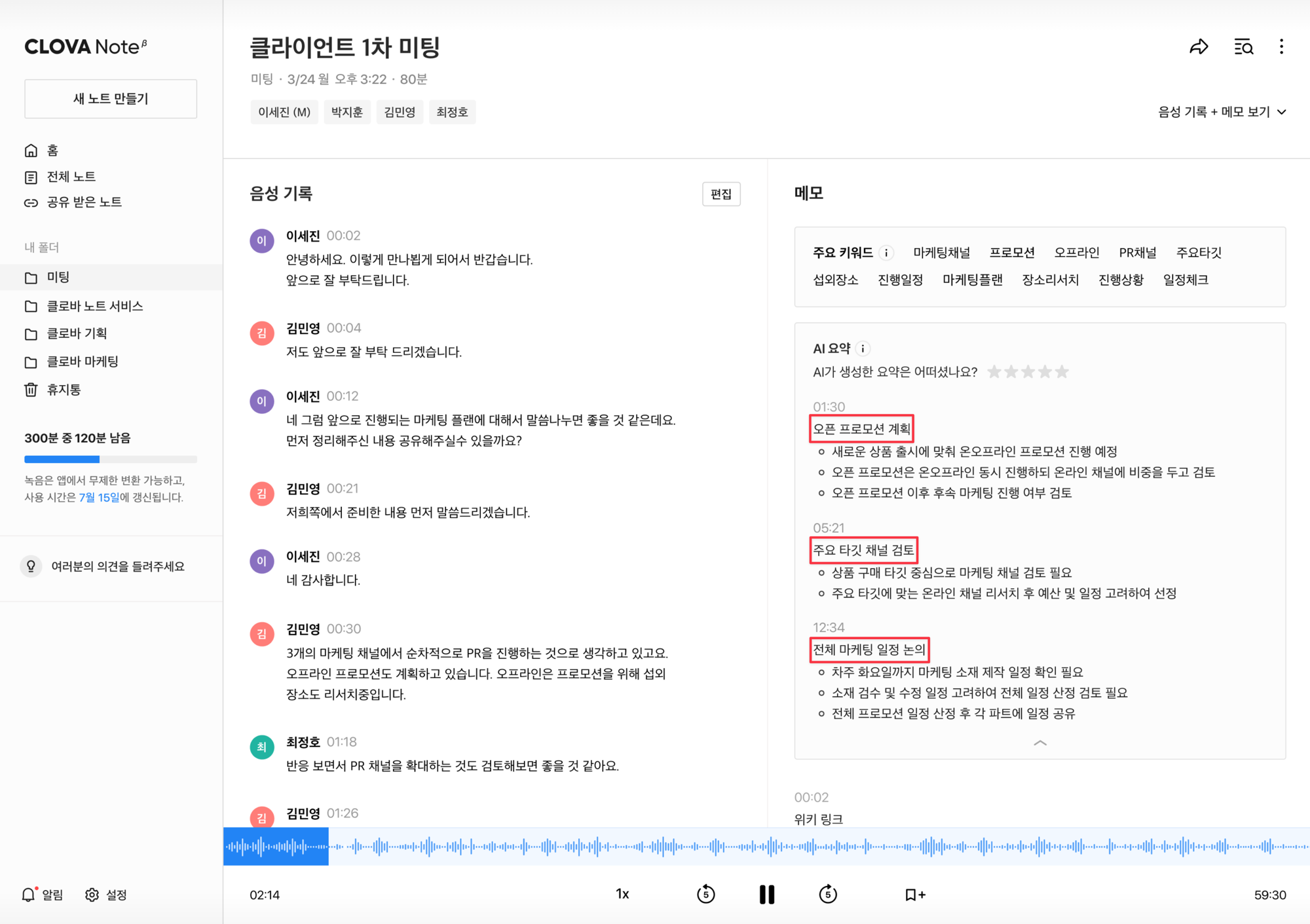
CLOVA Note — AI Summary Subtitles feature in production. Provides keyword extraction and subtitle-level summarization from voice recordings.
Technical Deep Dive
Model Architecture & Training
- • HyperCLOVA/LaRva backbone + LoRA (PEFT) adapter — summary→title generation SFT
- • Pre-DPO era (late 2022) — improved preferences purely through SFT + automatic data curation
- • Designed SFT iteration loop retaining only positive data for retraining
Multi-Criteria Filtering Pipeline
- • Bullet-point ending style check
- • Word count within 2–6 range filter
- • ROUGE-1 precision >= 0.75
- • Semantic similarity >= 0.9 via RoBERTa-HyperUNICON-based LaRva sentence encoder
Data Scale & Iterative Experiments
- • Train positive data 1,904→2,455 (+29%)
- • Error rates improved across all criteria — bullet-point -48%, word count -32%, ROUGE -33%, semantic -12%
- • Follow-up experiment — coverage 95.98%, valid bullet-point errors 12→1 (-92%)
Responsibilities
Trained CLOVA Note title generation model using HyperCLOVA/LaRva backbone with LoRA (PEFT) tuning
Analyzed weak labeling quality and designed positive filtering rules
Built multi-criteria data filtering pipeline based on bullet-point endings, word count, ROUGE-1 precision, and semantic similarity
Computed semantic similarity using RoBERTa-HyperUNICON-based LaRva sentence encoder
Developed Streamlit-based annotation/analysis tools — visualized weak label quality distribution and filter results
Built demo API — verified generalizability on OOD inputs (news articles, syllabi, English/Japanese)
Designed and iterated SFT loop retaining only positive data for retraining
Connection to Later Career
Data Quality-Centric Approach
At BHSN, designed weak supervision and automatic filtering for legal domain SFT data construction
Evaluation Metric Design
At BHSN, designed 20+ legal AI evaluation metrics and LLM-as-a-Judge framework
LoRA Tuning Practice
At BHSN, trained 5 task-specific adapters on Qwen2.5-14B backbone, contributed to predibase/lorax OSS
Applied NLP Delivery
Model training → data filtering → evaluation tooling → demo API — the prototype for end-to-end legal AI development
Skills Demonstrated
Continue exploring